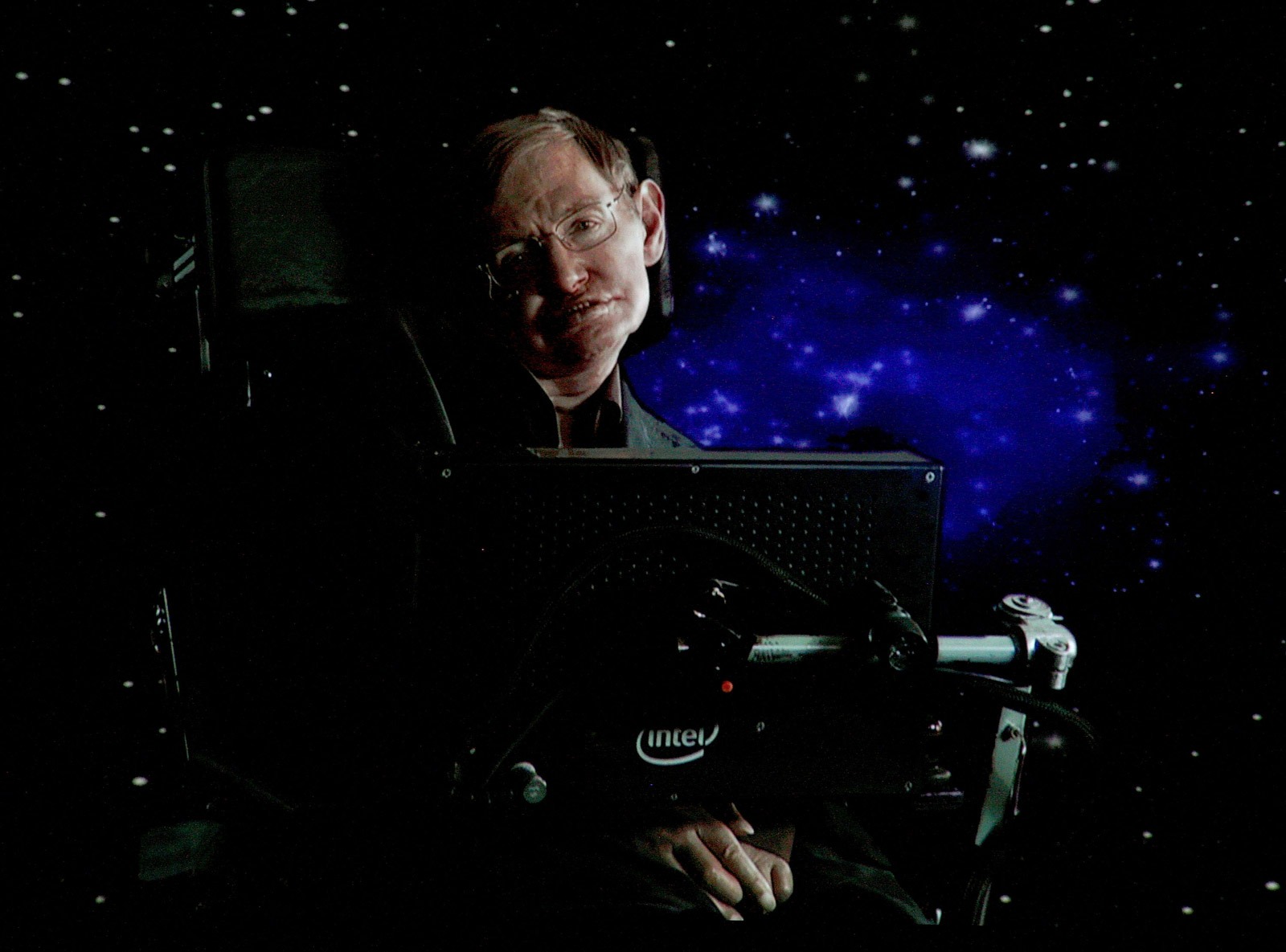
There are scientists who change what we know, and there are scientists who change the way the rest of us think about what we know. Stephen Hawking belonged in that second group. His name became glued to black holes, cosmology, and the deepest questions about time and space, but the part that lasted most might have been more human: he made the universe feel like something regular people could dare to wonder about.
Born in Oxford in 1942, Hawking moved to Cambridge in the early 1960s to pursue a PhD in cosmology. He gravitated toward questions that felt almost too large to hold, like where the universe came from, how it unfolded, and what happens beyond the limit of physical understanding. His early collaborations with Roger Penrose helped cement mathematical groundwork for the notion that the universe may have started from a singularity linked to the Big Bang.
Then came the trouble that would end up defining his career: black holes.
For years, black holes were seen as cosmic traps, locations from which nothing could come back out. Hawking made that picture harder, and in a way messier. In 1974, he said black holes are not entirely black, but they should emit thermal radiation, because of quantum effects that happen close to the event horizons. That whole effect got a famous label, Hawking radiation, and it changed how people study black holes, bringing together quantum mechanics, thermodynamics, gravity, and cosmology in one conversation.
The weight of it was more than a clean, neat name. The proposal implied that black holes have something like temperature and entropy, and they could, over incredibly long periods, drain away energy. It also triggered a deeper problem that still sits at the center of theoretical physics: the black hole information paradox. If matter goes into a black hole, and the black hole later evaporates, where does the information in that matter end up? Hawking’s work did not just deliver responses it pushed open new gaps in our understanding, right where physics meets the hard limits.
Yet Hawking’s public story was shaped by more than equations.
When he was a young researcher, he was diagnosed with motor neuron disease, and was told at first he would only have a few years to live. Still, he continued his research and later became one of the most recognizable scientists on the planet. The University of Cambridge also points out that he stayed scientifically engaged and publicly present right up to the end.
His physical limitations kept getting sharper and harsher, until eventually he needed a wheelchair and computer assisted communication to function day to day. But the tools that gave him a voice also turned into part of his public identity. Hawking refused to let the machinery of speaking become the boundary for what he thought about.
In 1988, he managed to reach an audience way beyond the scientific community with A Brief History of Time. The book tried to wrestle with themes like the Big Bang, black holes, the passage of time, and the arrangement of the universe, for readers who didn’t have advanced scientific preparation. It turned into an exceptional bestseller and kept sitting on the Sunday Times bestseller list for 237 weeks.
That kind of breakthrough shifted the public image of the theoretical physicist. Hawking showed up on television, gave public talks, took part in movies and documentaries, and even turned up in mainstream entertainment. His standing in science was serious and weighty, but his readiness to deal with popular culture made him something rather rare: a scientist who could be present all at once in the lab, the lecture room and the imagination of millions.
He also understood the importance of curiosity. At a Cambridge celebration for his 75th birthday, Hawking reflected on the extraordinary changes in how humans understand the universe during his lifetime and urged people to stay curious, and persistent
Hawking died in Cambridge on March 14 2018, when he was 76. Since then, his scientific papers, correspondence, photographs and personal materials have become part of a major archive at Cambridge University Library. It preserves not only his theories but the traces of the person behind them
His influence meanwhile keeps moving forward. In 2026, Cambridge appointed Daniel Baumann as the inaugural Stephen W. Hawking Professor of Cosmology, creating a chair that carries Hawking’s name into a fresh cohort of research
Stephen Hawking spent his whole life staring toward the largest questions imaginable. His legacy is not only that he pushed humanity to understand black holes, a bit more. It’s also that he reminded millions that the universe, however vast and mysterious, is worth the effort of understanding and yes, curiosity can become a kind of bravery by itself.