In the evolving architecture of the digital economy, where attention is currency and creativity a form of labor, Meta Platforms is once again recalibrating the rules. Its latest release of Facebook content monetization guidance is not merely a set of tips: it is a strategic manifesto, one that reveals how the company envisions the future of creators, content, and commerce on its flagship platform.
At a moment when competition from TikTok, YouTube, and emerging AI-driven platforms intensifies, Meta’s renewed emphasis on Facebook signals a broader shift: a return to roots, but with a sharper, data-informed edge.
A Platform Reawakens
For years, Facebook was considered a mature platform: ubiquitous, profitable, but no longer the epicenter of digital culture. That perception is changing. In 2025 alone, Facebook paid out nearly $3 billion to creators, a 35% increase year-over-year, underscoring a renewed commitment to the creator economy.
The latest monetization tips, released in March 2026, reveal how Meta intends to build on that momentum. At their core, the guidelines emphasize a simple but increasingly enforced principle: originality.
Meta’s systems are now designed to reward content that is “created, filmed, and produced” by the user, while demoting reposted or minimally altered material. This is more than an algorithmic tweak—it is an ideological stance against the proliferation of recycled content that has long defined social media feeds.
The message is clear: authenticity is no longer optional; it is monetizable.
The Reels Economy
If there is a centerpiece to Meta’s strategy, it is short-form video. Reels now dominate Facebook’s monetization ecosystem, accounting for roughly 60% of creator payouts.
This mirrors broader industry trends but with a distinct Meta twist. Rather than abandoning other formats, Facebook encourages creators to diversify: posting Reels, Stories, photos, and text—to identify what resonates with their audience.
Yet the hierarchy is unmistakable. Reels are the engine, the format most likely to generate reach, engagement, and ultimately revenue.
This dual approach – prioritizing short-form video while maintaining multi-format monetization, positions Facebook as both a competitor to TikTok and a more flexible alternative. It is a platform where a creator can experiment without being confined to a single medium.
Metrics as Motivation
Perhaps the most consequential shift lies in how success is measured.
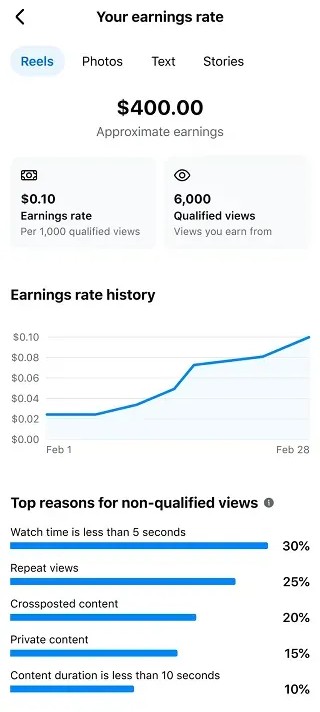
Meta has introduced new performance metrics: “qualified views,” “earnings rate,” and “non-qualified views” – designed to give creators a clearer understanding of how their content translates into income.
These metrics reflect a deeper transformation in platform economics. Engagement alone is no longer sufficient; what matters is meaningful engagement: longer watch times, authentic interactions, and content that holds attention.
In effect, Meta is redefining value. A viral clip may generate millions of views, but if those views are fleeting or deemed low-quality, they may not translate into earnings. Conversely, a smaller but more engaged audience can prove more lucrative.
This recalibration aligns with Meta’s broader push toward sustainability in the creator economy – favoring depth over breadth, substance over spectacle.
The War on Engagement Bait
Alongside its emphasis on originality, Meta is cracking down on what it calls “engagement bait”: content designed solely to manipulate user interactions.
Posts that prompt users to “like, share, or comment” in artificial ways are increasingly penalized, both in distribution and monetization potential.
This policy reflects a growing awareness of the unintended consequences of algorithm-driven platforms. For years, creators optimized for virality, often at the expense of quality. The result was a flood of low-value content that undermined user experience.
By deprioritizing such tactics, Meta is attempting to restore balance – encouraging creators to focus on storytelling, insight, and genuine connection.
New Pathways to Profit
Beyond content itself, Meta is expanding the ways creators can earn.
Recent updates include the reintroduction of affiliate marketing tools, allowing creators to tag products directly in posts and Reels. This integration transforms Facebook into a hybrid platform – part social network, part marketplace.
Creators can now embed up to 30 products in a single piece of content, linking directly to partner platforms like Amazon. The implications are significant: content becomes commerce, and influence becomes measurable revenue.
At the same time, initiatives like the “Creator Fast Track” program offer guaranteed earnings and increased reach for eligible creators, further lowering the barrier to entry.
Together, these tools signal a shift from passive monetization to active entrepreneurship. Creators are no longer just participants in the platform: they are business operators within it.
A Competitive Landscape
Meta’s renewed focus on Facebook monetization must be understood within a broader competitive context.
Platforms are no longer just spaces for sharing content; they are ecosystems competing for creators. TikTok offers virality, YouTube provides long-form stability, and emerging AI platforms promise automation and personalization.
Meta’s response is multifaceted: financial incentives, advanced analytics, integrated commerce, and a renewed emphasis on originality.
It is also investing heavily in artificial intelligence, aiming to automate advertising and enhance content discovery. These investments suggest that the future of monetization will be increasingly data-driven, with algorithms playing an even greater role in determining success.
The Creator’s Dilemma
For creators, these changes present both opportunity and challenge.
On one hand, the potential for earnings has never been greater. With billions paid out annually and new tools emerging, Facebook offers a viable path to financial independence.
On the other hand, the bar has been raised. Originality, consistency, and strategic thinking are now prerequisites for success.
The days of effortless virality are fading. In their place is a more demanding, but potentially more rewarding, landscape – one where creativity must be paired with discipline.
A New Social Contract
Ultimately, Meta’s new monetization tips represent more than a technical update. They signal a new social contract between platform and creator.
In this contract, Meta provides the tools, distribution, and financial incentives. In return, creators are expected to deliver authentic, engaging, and original content.
It is a symbiotic relationship, one that reflects the maturation of the creator economy.
As Facebook continues to evolve, one thing is certain: the era of casual posting is giving way to a more intentional, professionalized form of digital expression. For those willing to adapt, the rewards may be substantial. For those who cannot, the algorithm will quietly move on.
In the end, the question is not whether creators can succeed on Facebook, but whether they can meet the platform’s new definition of value.