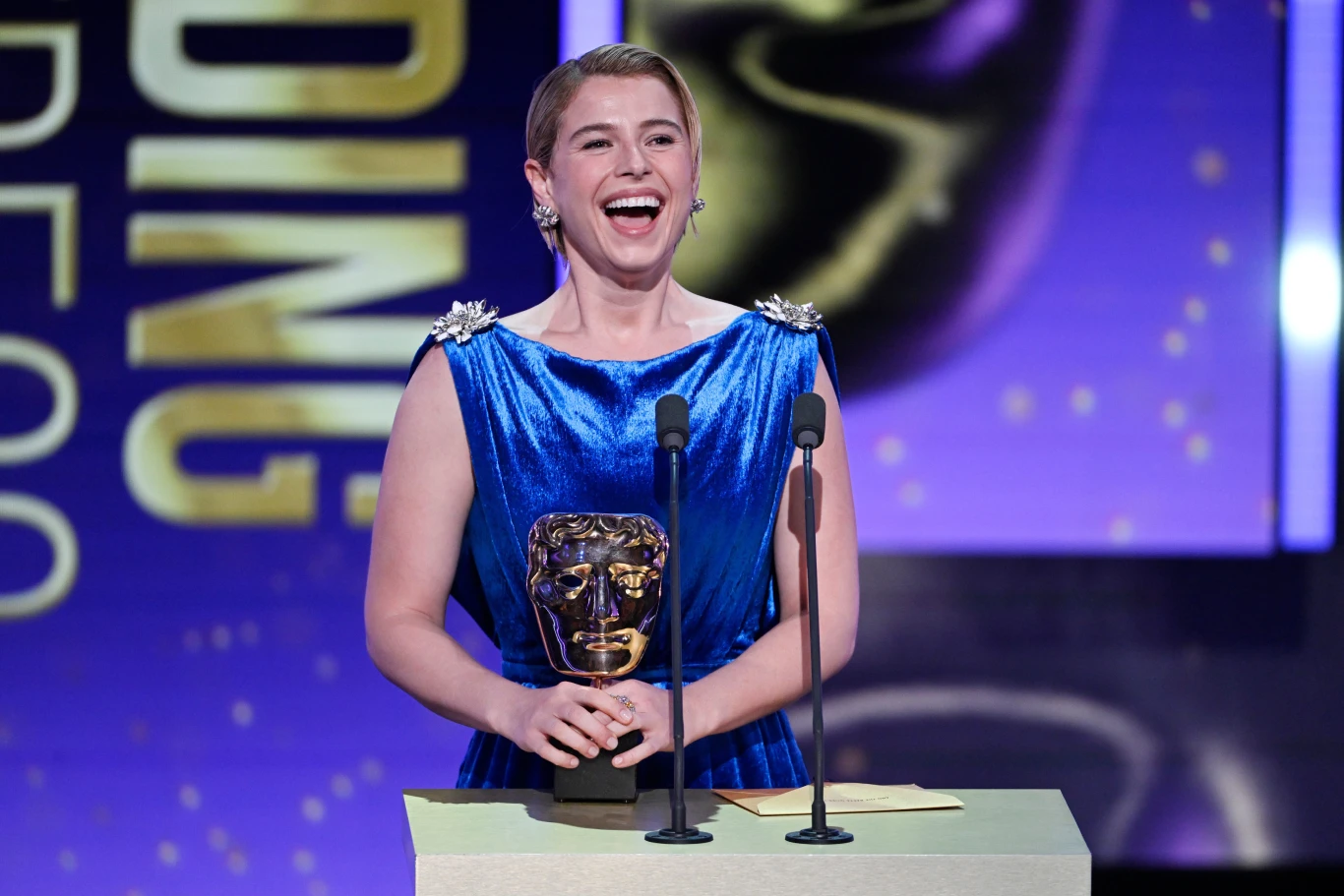
Jessie Buckley took to the stage to accept the lead actress role during the British Academy of Film and Television Arts, but instead of beginning with the trade talk, she began to confess.
She told the audience that all those years ago, she was just a teenage girl from Ireland with this very disproportionately sized dream of being a star, like Judi Dench. Then, she was not traipsing through the pulchritude of a red carpet, but sitting mildewing in a life-sized bedroom where she experimented and dreamed of acting-and had used, as she quipped through sobs, a “nuclear bad fake tan.” This particular image was neatly balanced between two extremes. On the one hand, it could be construed as an emblem of false modesty, as if the young woman only looked the part before she could actually sustain it.
In a moment on one of the most hallowed British stages, Buckley became the very arc the carpet allows awards show to immortalize. Her voice gave no hint at career strategy or industry politics. Instead, she spoke about the power of transformation that motherhood has wielded over her definitions of success.
“The best role of my life is being a mum,” her voice was breaking.
In a sort of different tenor, that line filled the space where victory speeches usually go. In an industry that champions the best legitimate strategies accepted by prestigious projects and box-office boons, Buckley inverted the binary. While the award for her and her role was meaningful and well earned, it was only one stepping-stone on her path.
The Long Road to the Stage
Buckley’s career has been marked by fervor and risk. Actor of intense performances and emotionally wide-ranging characters, she has built the reputation of an arist who doesn’t simply glide through roles but becomes them outwardly. Her work has been jump-cutting between stage and screen, independent film and big productions where it is always underpinned by a quality of rawness that is at once disciplined and instinctively.
In her talk, though, she reminded that what is now unceasingly raging on the stage itself was being shaped through so great a lot of fear and trepidation. Even as a teen, she went to auditions and failed, went back home to think on her performance, and kept on coming again. She saw herself more as someone burning intensely with desire than as someone with some kind of genius, she is amusing.
The fake tan story”, told in fondness rather than embarrassment, ended up being the ultimate metaphoric symbol of the extreme beginning of her desire. It was the visual symbol of aspiration without any polish. The girl who wanted to change into someone good enough for a dream.
In this sense, the leap from bedroom rehearsing to award recognition was less of a metamorphosis than persistence. Buckley did not discard her past self. She carried it forward — confidence layered onto vulnerability.
Motherhood as Transformation
Most significantly changed, she said, was not the award but giving life. The birth of a child re-formulated time, priorities, identity. All of sudden, the industry’s rhythms, long shoots, press tours, unpredictable schedules, were alongside school runs, bedtime routines, and simple home-care negotiation.
Instead of painting motherhood as a huddle to artistic spirit, Buckley offered a different perception, saying it enhances her as an artist. The emotional gamut of parenthood-patience, resilience, uncertainty-pervades one’s art. Family offers grounding against a backdrop of a profession that can easily lose identity to show business.
Her gratitude onstage was directed not just outwardly at all the collaborators and voters but primarily inward at the realization that her life now includes a role given out without reviews from critics and a vote that doesn’t culminate in statuettes. Being a mother, she implied, does not have a premiere night. It is a success every day.
The reaction of the audience was immediate and warm. A room living off glamour and competition felt quiet in the face of Buckley’s audacity. No triumphalism, no branded content; just an artist in acknowledgement of the fact that success has changed shape for her.
Awards Season vs. Authenticity
Most people tend to use their acceptance speeches to portray a successful career. This, instead, served as a turning point in Pat’s life. Rather than glorify the myth of the relentlessly ambitious, she reframed it through humility. The Judi Dench wannabe comment was not one of comparison but, rather, of inspiration, paying homage to all the British and Irish performers she once revered and now stands beside.
One thing Buckley did skillfully was to tether together childhood and adolescence — a young and shiny person still in the throes of identity experimentation and the highly responsible drag of being an adult. Here, the stage sank from a mere ambition in the journey of time into merely a check-point in a progressive series of runs.
Her win, therefore, obvious in its nearness to Peggy Lee, was also a pointer to the current going on with the industry. As awards talk reflects, the present era seems to be acknowledging that art is living and that actors live off the sets of their work. Society no longer expects growth outside life apart from professional recognition, with these two intertwined.
Buckley’s most cunning stroke lay in her referring to that union. A speech that left an afterglow that she is, after all, the same person off-screen that we expect her to be while on.
What It Was to Be the “Best Role”
However, the phrase did not, in any type of way, take away from her craft, and moreover, it viewed the same from a different angle. Something unknown to the actual profession of acting: The personal being.
Buckley’s note seemed quietly revolutionary in a culture that often associates praise with worthiness. It just said: Art serves in a grander picture of humans than accolades. Awards have their place in appreciating craft and may be helpful in opening some doors, for adding turning points. However, they do not mark a life in full.
She had done something fine by the time she got off the stage. She had bound the aspiration onto proof–the desire for acceptance with proof. The aspiration met with grounding, ambition united with this real, concrete sense of accomplishment, fused with thanks and love.
With her experimental tan and dreams of being Judi Dench, the young girl may have envisioned this moment much differently. But someone has said that Buckley’s track to acceptance has rarely been straight-one that fulfillment can sometimes be unexpected.
Her tearful words define the kingdom of child’s influence. Trophies may line the shelves, but it’s the children that mold futures.
She had both for just one night – an award for best actress with her at the end of the day, and the feeling of having thoroughly and very gratifyingly performed this very same role at home. How impossible it is, then, for any screenplay to neatly sew up the mention of such?