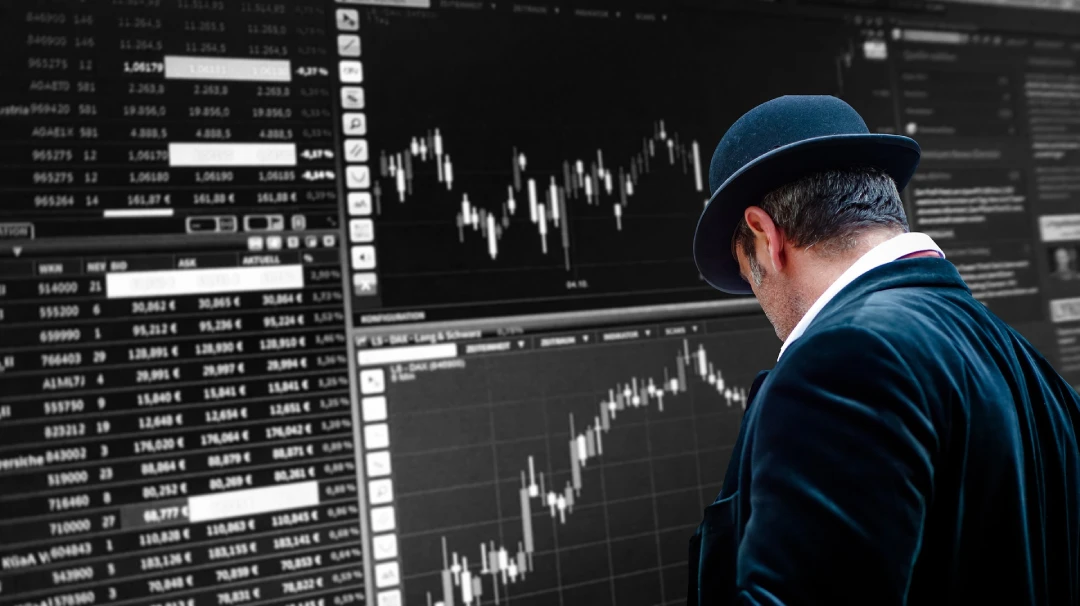
Wall Street is historically good at pricing in drama, but once trade policy starts moving away, investors do just about what they hate doing: sitting on the fence. This feeling seems to be rolling down global markets due to another round of tariff fears with the possible future augmentation in tariffs that would further upset the monetary landscape.
The increased volatility is arising with speculation adrenaline, trying to find out how a future trade agenda under Trump would reshape international commerce. Long before any policy changes are coming on white paper, just the mere thought of tariff expansion has been enough to trigger a pause on every trading floor of New York or Tokyo. Indeed, investors begin to remember the last time that tariffs commanded such headroom from the market: the back-breaking supply chains, all murky corporate planning, and midnight market swings or drops at every mention of “tariff”.
This time around is more like an evolving storm than a sudden blast of news once for all time, as the shaky equity indices and industrial stocks wavered under the semantics of higher costs. The seemingly uncertain future of trade talk narratives was tying the difference in the ciphers of equity prices of companies that are reliant on cross-border components-automakers, semiconductor makers, or even retailers, while traders sought to figure out if tariffs would be raised, widened within, or merely employed to secure a bigger sort of negotiation.
The thing about tariffs isn’t just that they’re tariffs – it’s the uncertainty. Businesses can deal with higher costs if they are familiar with the boundaries of the rules of engagement. They can adjust their supply chains, renegotiate contracts, absorb some margin pressure, or switch over from China to Vietnam as their operation. Could work itself up with the policy uncertainty, such as an abrupt rate change or extended future coverage? What if it aims to remedy the labor practices in the world very quickly?
Global trade is fundamentally rooted in interdependence. Modern commodities often pass through several countries before they reach consumers-and, so to speak, move back and forth across borders. Tariffs, entering this act, are very disruptive, making prices higher at different steps and in ways too complex to imagine for many industries. Investors, reactive to signs that augur increasing cross-border friction, may rein in their appetite for risk.
The reaction of foreign exchange markets is equally prevalent. From traders taking to organic havens to dollar appreciation at some point in time, these vandalism makers while discussing tariffs bring untold pressure upon economies that rely so much on exports. Since emerging markets are the most affected within the family of systems receipt toward global solace, the flows become abrupt. Hence, once uncertainty peaks in any form, funds can flow out at almost lightning speed, subsequently creating ripple effects beyond the policy trials.
While anxiety for corporations is tribal, to a great extent it boils down to mere practicality. Through their experiences in the previous rounds of tariff hikes, large corporations have come to learn how inevitable and unavoidable the ramifications of a customs blow are. Most have resorted to securing their supply chains well by going for diversification of suppliers, increasing buffer-stock technology at domest(th)ic levels, and reviewing contractual contingencies more seriously. This has also seen the reconstructed production of some de-shored works while the adaptation/rewriting of existing operations in order to add some flexibility to their trading strategies. Of course, such efforts are by no means non-costly nor free of administrative hassles; hence, rather than stringent compliance with the tariff impositions announced or in waiting, regulatory adjustments would likely amount to revising: therefore, fresh investment is more or less what’s needed which top management finds almost impossible until they’ve seen the final mar.
Consumers, however, feel the secondary impacts of while markup in diverse ways. In this framework, tariffs can generate higher input prices for businesses signifying higher retail prices. The threat lies in inflation in quite a few conversations, with rumors to the metal in the electronic, appliance, and automotive industry, as these other industries are not under the burden of a single entity. Surcharges can be levied on the cost for even the slightest increases in the cost price.
Yet, the market is not merely reactive; it is anticipating some future event. Some investors argue that current volatility is more about uncertainty than chaos, with trade tensions providing negotiation tools devoid of permanent policy implications. Therefore, they suggest, calm will return upon acquisition of a better knowing and understanding. There were cases in the past where, after some of the perturbations caused by tariffs, partial agreements were reachable, or within particular sectors certain adjustments able to be found.
However, the global context is important. International trade is extremely interrelated today, within a hard-won multilateral system of agreement over the years. Departure from this structure on any significant scale, and especially as an extensively implemented measure – threatens for years to alter the tendencies in investments. For multinationals deciding where to allocate their capital, policy predictability is just as fundamental as tax rates or labor costs. Uncertainty delays the development of projects, makes as much as the hiring process a slow one or significantly dampens corporate confidence.
The financial analysts are already adjusting the forecasts. Therefore, while still swiftly adjusting their volatility varies upward, although they still made their clients wary about the single-event strategy of tall bets within scenarios. Hedge funds and institutional investors, ever sensitive to government tendrils, have between them also scaled up all positions into the possibility of trade disruptions.
Without a great degree of separation between politics and business, the trade terrain has become a great talking point in the policymakers’ toolkit, and matches the discussion at hand. While the proponents of trade see it as a means to protect domestic industries and rebalance trade relations, the antagonists argue that tariffs may lead to retaliation, de-centralization of the supply chains, and eventually dampen growth.
For markets, however, purity/truth argument recedes into being gradually eclipsed by issues of visibility. When the rules are clear, one can discern the pros and cons of a competition, while in the event of ambiguity, risk becomes difficult to evaluate. As long as there is a tone of uncertainty regarding the tariff situation, mostly in the course of electioneering and reconstruction of government, the actors in trade will silently factor in the possibility of impediment. That means that you are grappling with scarcity and lining up to interpret every statement anew for that occasional volatility.
Will this uncertainty become a defined policy framework, or is it here to stay as a to-and-fro feature? Should tariffs become rooted in position, global trade patterns would slowly tilt while businesses revamp strategies for minimal exposure. If they remain a tool of bargaining more than anything else, the markets might eventually recalibrate, making some sense out of it all and regaining some stability.
But for now, imagine wading through a landscape abstracted by only imagination and stalemated by U. S. solidified hope. As yet, both the availability and unavailability of policies have brought a lot of uncertainty. Many concerns then.
Glowing with real-time updates, trading atmospheres are confined to the room, but the uncertainty factor still hangs on political grounds. As long as global business lies suspended with the uncertainty of tariff hikes, markets are going to vibrate-from balancing of risks through investment and economic data and speech on trade.