New discovery refutes earlier theories regarding Earth’s “twin” planet.
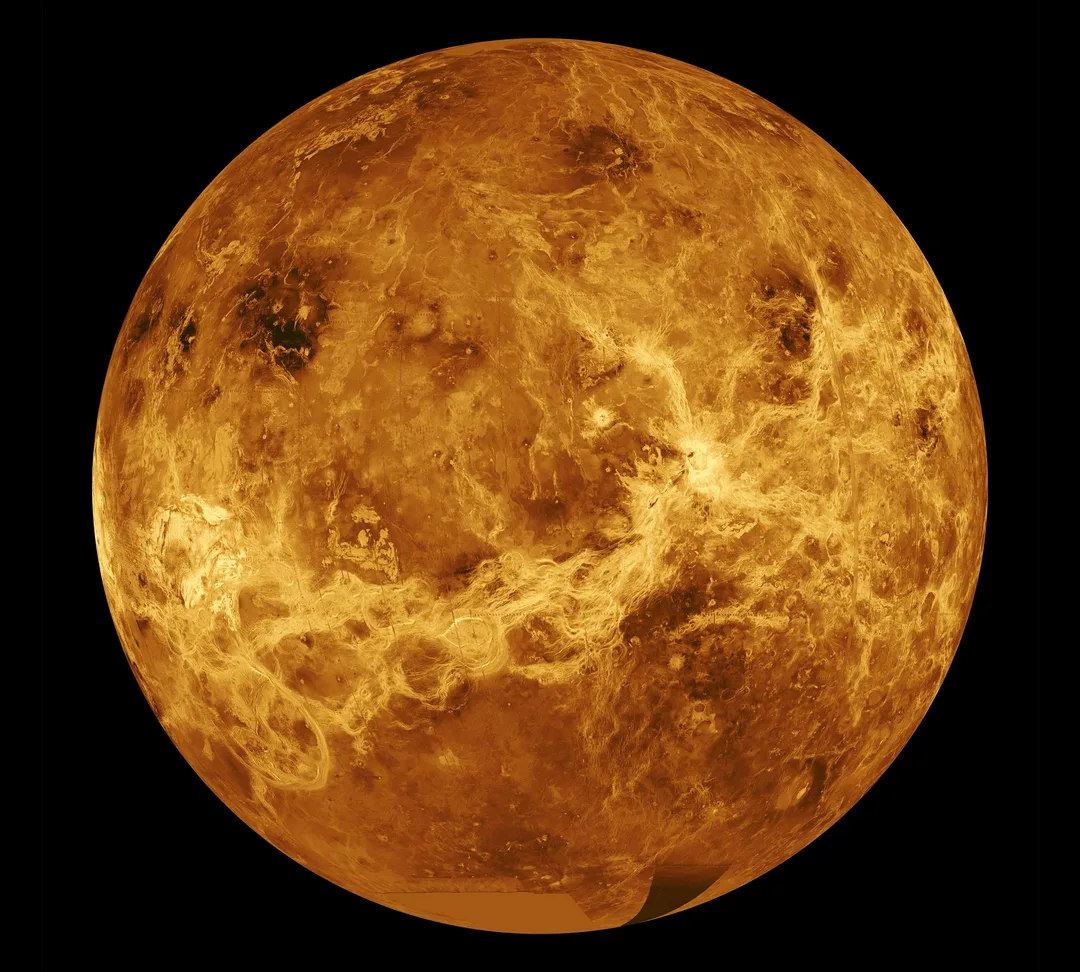
In a groundbreaking discovery, NASA researchers have disclosed that Venus, which has been referred to as Earth’s twin owing to its comparative size and constitution, has a surprisingly thin crust with evidence of active geology. This revelation contradicts traditional understanding of the geologically inactive nature of the planet and provides new information on its dynamic core.
Scientists used to assume that the crust on Venus would be thick and stagnant because the planet doesn’t have plate tectonics—a process that recycles the crust of Earth and powers geological activity. New research indicates otherwise. According to advanced computer models, scientists have calculated that Venus’ crust is much thinner than expected, with an average thickness of around 25 miles (40 kilometers) and a maximum of 40 miles (65 kilometers) in thickness.
This thin crust undergoes a special process. When it becomes thicker, the denser lower layers become unstable and either get detached into the mantle or are melted, thus stopping indefinite thickening. This process, different from Earth’s plate tectonics, means that Venus also has its own process of crustal recycling, which can cause volcanic activity on the planet.
More proof of Venus’ active geology is contained in research of surface features referred to as coronae—immense, circular formations produced by upwellings of melted material. Data from NASA’s Magellan mission indicate that these features continue to be modified by tectonic forces, which means that there is active geological activity present below the planet’s surface.
Furthermore, the fact that there are rift zones, like Devana Chasma, and other volcanic structures, like pancake domes and scalloped margin domes, also leads to the conclusion that Venus is active geologically. These would be the outcomes of the internal heat of the planet and convective flow in its mantle.
Implications for Planetary Science
The presence of Venus’ thin crust and active geology is a significant discovery that has ramifications in the field of planetary evolution. It implies that a planet can still have geological activity, even without plate tectonics. It not only revolutionizes our understanding of Venus but also leads us to reassess the geological processes of other bodies.
Additionally, knowing the geology of Venus may help reveal more about Earth’s geological past and what makes a planet habitable. Through Venus, researchers can gain more understanding of what makes a planet life-supporting.
To learn more about Venus’ geology, NASA and the European Space Agency (ESA) have scheduled a number of missions. NASA is sending its DAVINCI and VERITAS missions to examine the planet’s atmosphere and surface more closely, while ESA is sending EnVision to map Venus’ surface and study its geological activity.
These flights will yield valuable information that will help us better understand the interior dynamics, surface processes, and habitability potential of Venus in the past or present.
The discovery of Venus’ unexpectedly thin crust and evidence of active geology is a major leap forward in planetary science. As scientists continue to probe the mysteries of Earth’s next-door neighbor, these results reinforce the dynamism of planetary interiors and the variety of mechanisms behind geological activity throughout the solar system.