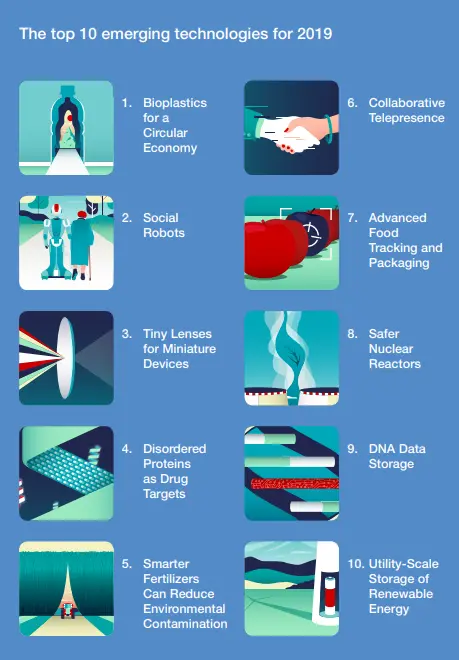
The year 2019 marked a turning point in technological innovation, with groundbreaking advancements that promised to redefine industries, improve lives, and address global challenges. From sustainable solutions to cutting-edge medical breakthroughs, these emerging technologies showcased the power of human ingenuity. Let’s explore the top 10 technologies that captured the world’s imagination in 2019 and their potential to shape the future.
1. Bioplastics for a Circular Economy
Plastic pollution has long been a pressing environmental issue, with less than 15% of the world’s plastic being recycled. In 2019, bioplastics emerged as a promising solution. These biodegradable materials, derived from plant waste like cellulose and lignin, offered a sustainable alternative to conventional plastics. By promoting a circular economy, bioplastics aimed to reduce waste and minimize environmental impact.
2. Social Robots
Robots capable of recognizing voices, faces, and emotions became increasingly sophisticated in 2019. Social robots, designed to interact with humans in meaningful ways, found applications in education, healthcare, and customer service. These droid companions not only assisted the elderly and educated children but also demonstrated the potential of robotics to enhance human well-being.
3. Metalenses
Traditional glass lenses, used in cameras and medical devices, faced limitations in size and weight. Enter metalenses—ultra-thin, flat lenses made possible by advances in physics. These innovative lenses allowed for miniaturization in optical devices, paving the way for more compact and efficient technologies in imaging and sensing.
4. Disordered Proteins as Drug Targets
Proteins that lack a rigid structure, known as intrinsically disordered proteins, have been linked to diseases like cancer. In 2019, scientists developed methods to stabilize these proteins long enough for treatment to take effect. This breakthrough opened new avenues for drug development, offering hope to patients with previously untreatable conditions.
5. Smarter Fertilizers
Agriculture saw a leap forward with the development of smarter fertilizers. These advanced formulations released nutrients only when needed, reducing environmental contamination and improving crop yields. By addressing the inefficiencies of traditional fertilizers, this technology contributed to sustainable farming practices.
6. Collaborative Telepresence
Imagine attending a meeting or event virtually, yet feeling as though you’re physically present. Collaborative telepresence, enabled by advancements in virtual and augmented reality, brought this vision closer to reality in 2019. This technology had the potential to revolutionize remote work, education, and social interactions, breaking down geographical barriers.
7. Safer Nuclear Reactors
Nuclear energy, while a powerful source of clean energy, has faced safety concerns. In 2019, innovations in reactor design and resilient fuels aimed to address these challenges. Safer nuclear reactors promised to make nuclear power a more viable option for meeting global energy demands while minimizing risks.
8. DNA Data Storage
The exponential growth of digital data posed a challenge for traditional storage methods. DNA data storage, inspired by nature’s own information system, emerged as a revolutionary solution. By encoding data into DNA molecules, this technology offered unparalleled density and durability, with the potential to store vast amounts of information in a tiny space.
9. Utility-Scale Energy Storage
Renewable energy sources like solar and wind are intermittent by nature, requiring efficient storage solutions. Utility-scale energy storage systems, developed in 2019, addressed this challenge by enabling the storage and distribution of renewable energy on a large scale. This innovation was a critical step toward a sustainable energy future.
10. Advanced Food Tracking and Packaging
Food safety and waste reduction became priorities in 2019, leading to advancements in tracking and packaging technologies. Smart packaging, equipped with sensors and indicators, provided real-time information about food freshness. These innovations not only improved food safety but also helped reduce waste by extending shelf life.
The Impact of Emerging Technologies
The technologies of 2019 demonstrated the rapid pace of innovation and its potential to address pressing global issues. From environmental sustainability to healthcare and energy, these advancements offered solutions to some of the world’s most significant challenges. However, they also raised important questions about ethics, accessibility, and the unintended consequences of technological progress.
Looking Ahead
As we reflect on the emerging technologies of 2019, it’s clear that innovation is a driving force for change. These breakthroughs not only showcased human creativity but also highlighted the importance of collaboration between scientists, engineers, policymakers, and society at large. By harnessing the power of technology responsibly, we can build a future that is sustainable, inclusive, and resilient.
by Johnny Wood